
|
Getting your Trinity Audio player ready...
|
At a recent event, Google’s Search Liaison Danny Sullivan did something Google almost never does: he said the quiet part out loud.
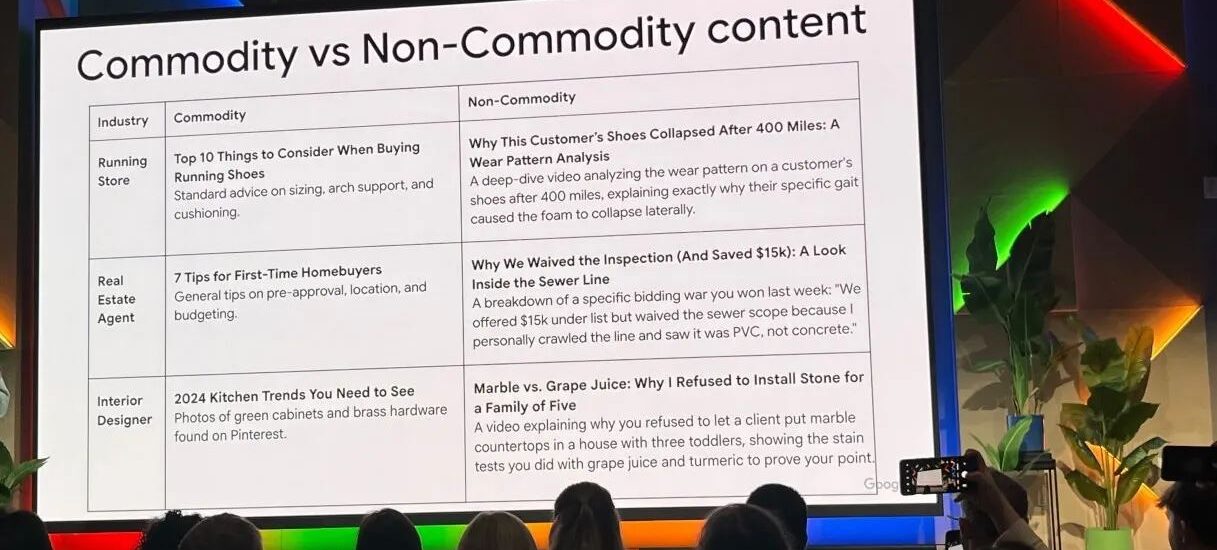
He put up a slide. Two columns. Commodity content on the left. Non-commodity content on the right. And without much ceremony, he explained which one Google is built to reward going forward — and which one it isn’t.
If your content looks like the left column, you have a problem.
The Slide Every Small Business Owner Needs to See
The examples Sullivan used were blunt by design.
A running store publishing “Top 10 Things to Consider When Buying Running Shoes” — standard advice on sizing, arch support, cushioning — is producing commodity content. It’s the same article that exists on 4,000 other websites. Google has no reason to surface yours over anyone else’s.
The non-commodity version? “Why This Customer’s Shoes Collapsed After 400 Miles: A Wear Pattern Analysis” — a deep-dive video explaining exactly why a specific customer’s gait caused the foam to collapse laterally.
One of those articles could only have been written by someone who actually does this work. The other could have been written by anyone with a laptop and an hour to spare.
Google is getting much better at telling the difference.
This Isn’t New. It’s Just Finally Being Said Clearly.
Google has been signalling this direction for years through E-E-A-T — its framework for evaluating Experience, Expertise, Authoritativeness, and Trustworthiness. The first E — Experience — was added specifically to capture something AI-generated content structurally cannot fake: the knowledge that comes from actually doing the thing.
Sullivan’s slide is E-E-A-T with the jargon stripped out. It’s Google saying: we want content that couldn’t exist without you specifically having created it.
The real estate agent who shares a breakdown of a specific bidding war they won last week, including the exact reasoning behind waiving an inspection because they personally crawled the sewer line and identified it as PVC — that’s non-commodity content. The article about “7 Tips for First-Time Homebuyers” pulled from general knowledge is not.
Most Small Business Content Is the Left Column
Here’s the uncomfortable truth: the majority of small business websites are full of commodity content. Not because the business owners aren’t experts — they absolutely are — but because when it comes to content, most businesses default to what feels safe and generic.
Safe topics. Broad advice. Nothing too specific, nothing too opinionated, nothing that couldn’t apply to anyone.
That instinct made some sense when SEO was primarily about keywords and volume. It makes no sense now.
The irony is that small businesses are often sitting on extraordinary non-commodity content and not using it. The specific job that went wrong and what you learned. The question a customer asked last week that nobody else seems to answer clearly. The decision you made that was counterintuitive and why. The thing you’d tell a client who was about to make a common mistake.
That’s the content Google just told you it wants. You already have it — you’re just not publishing it.
What Non-Commodity Content Actually Looks Like For Your Business
You don’t need a production budget or a content team. You need specificity.
Ask yourself: what do I know about my industry or my clients that a generalist couldn’t write from a Google search? What have I seen, done, or decided that required real expertise to get right?
Then write that. Exactly that. With the specific details intact — the numbers, the names (where appropriate), the reasoning, the outcome.
The interior designer who refused to install marble countertops for a family with three toddlers, ran grape juice and turmeric stain tests to prove the point to a sceptical client, and documented the whole thing? That’s a post nobody else on the internet has. It demonstrates expertise in a way that a listicle about kitchen trends never could. And it’s exactly the kind of content Google has just publicly said it wants to reward.
The Content Gap Is a Business Opportunity
Most of your competitors are still publishing the left column. Which means the non-commodity space in your industry is largely empty.
That’s not a content strategy problem. That’s an open door.
The businesses that walk through it now — while everyone else is still debating keywords and posting generic tips — are the ones that will own their niche in search, in AI recommendations, and in the minds of the customers who find them.
Google told you what they want. The question is whether you’re going to give it to them.
Not sure what your non-commodity content looks like? That’s exactly what I help small businesses figure out. Let’s talk about what you’re sitting on.