
|
Getting your Trinity Audio player ready...
|
You open Google Analytics. The line is going down. Again.
You’ve been publishing consistently. Your website looks good. You haven’t done anything wrong. But the numbers keep dropping, and nobody can tell you why.
Here’s what nobody is telling small business owners: a drop in website traffic right now is not a sign that your marketing is broken. It’s a sign that search itself is broken — and it’s being rebuilt.
The businesses that understand this shift are quietly winning while everyone else is panicking over their dashboards.
What’s Actually Happening to Search
For about two decades, the model was simple. Someone had a question. They typed it into Google. Google showed them ten blue links. They clicked one. You got a visitor.
That model is over.
Today, a growing share of searches never produce a click at all. Google’s AI Overviews answer the question right there on the results page. ChatGPT answers it conversationally. Perplexity synthesises five sources into a paragraph. The person gets what they need and never visits anyone’s website.
This is called zero-click search, and it’s not a bug. It’s the new design.
According to HubSpot’s 2026 State of Marketing Report, more than half of marketers — 58% — say their search volume is down but their searches have higher intent. Meaning: fewer people are arriving at websites, but the ones who do are much more ready to buy.
Read that again. Fewer visitors. Better visitors.
Why Fewer Visits Can Mean More Business
Here’s the mental shift that changes everything.
Old model: Traffic → hope some of it converts
New model: AI filters for intent → fewer but better visitors arrive
Think about it from a customer’s perspective. Before AI search, someone researching “best accountant for freelancers” would click through five or six sites, skim each one, get confused by conflicting information, and maybe fill out a contact form on the third visit after coming back two weeks later.
Now? That same person might ask ChatGPT, get a useful answer that mentions a few trusted names, visit one or two of those businesses directly, and make a decision that day.
The visitor count goes down. The conversion rate goes up.
This is already showing up in real data. Marketers report that visitors arriving via AI tools are converting faster and arriving further along in the buying journey. Traditional search volume is projected to decline 25% overall — but the traffic that remains is qualitatively better.
But What If AI Doesn’t Mention You At All?
This is the right question to be asking.
The businesses that thrive in AI search are not the ones with the most content. They’re the ones that AI can confidently recommend. That means demonstrating real expertise, answering specific questions clearly, and building the kind of authority that makes an AI system comfortable putting its reputation behind a recommendation.
One way to think about it: your future customer is having a conversation with an AI assistant and asking “who should I use for X?” Unless you’ve published clear, trustworthy, expert information that answers that question, the AI will recommend someone else.
This is where E-E-A-T — Google’s framework of Experience, Expertise, Authoritativeness, and Trustworthiness — becomes central. It was designed for human readers, but it turns out it’s exactly what AI systems look for too.
What This Means for Small Businesses (Hint: It’s Good News)
Here’s something the big-budget marketing world doesn’t want you to know: AI-powered search has genuinely levelled the playing field.
Old SEO rewarded whoever could afford the most backlinks, the most content volume, and the most technical optimisation. Small businesses couldn’t compete with enterprise marketing budgets.
AI search rewards something different: real expertise and genuine answers to real questions.
A local physio who writes clearly about the three most common causes of lower back pain and what to actually do about them can outperform a national health conglomerate publishing generic, keyword-stuffed articles. A boutique accountancy firm that clearly explains the tax implications of going limited for a sole trader is more valuable — to AI and to real humans — than any number of brand awareness campaigns.
Your expertise is your competitive advantage. It always was. AI search is finally the tool that rewards it.
What You Should Do Right Now
The traffic drop is not the problem. The problem would be doing nothing while the rules change.
Three things to focus on:
1. Stop optimising for clicks. Start building authority.
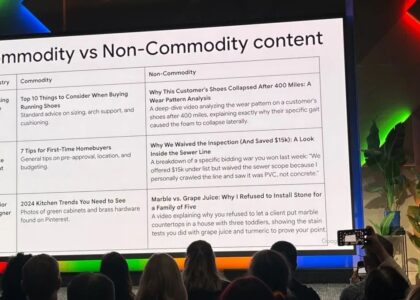
Think about the questions your best customers ask before they hire you. Write the best possible answer to those questions — not the most keyword-stuffed version, the most genuinely useful one. That content gets cited, referenced, and surfaced by AI systems.
2. Make your content easy for AI to extract.
This doesn’t mean gaming the system. It means structuring your information clearly: direct answers near the top of each page, simple headings that match how people ask questions, FAQ sections that mirror real customer queries. The same structure that makes content easy for AI to summarise makes it better for human readers too.
3. Measure differently.
If you’re only watching visitor counts, you’re looking at the wrong dashboard. Watch for branded searches increasing (people who’ve heard of you), track enquiry quality not just volume, and pay attention to conversion rate. A site that gets 800 visitors and converts 12 is healthier than one getting 2,000 visitors and converting 8.
The Honest Bottom Line
Your traffic is probably going to keep dropping. Not because you’re doing something wrong — because the entire system that delivered that traffic is being replaced by something fundamentally different.
The businesses that treat this as a crisis will chase old metrics that no longer mean what they used to.
The businesses that treat this as an opportunity will spend the same energy building the kind of content authority that AI search actually rewards — and they’ll find that fewer visitors means more business, not less.
The rules changed. The opportunity is still very much there.
Ready to stop chasing old metrics and start building content that actually works in 2026? I help small businesses create the kind of authoritative, AI-ready content that gets found — and converts. Let’s have a conversation.